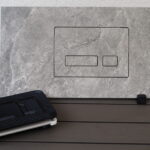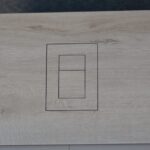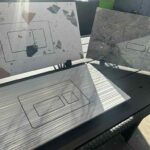
A wall-hung toilet can look perfectly considered until the flush plate interrupts the surface with a contrasting rectangle. Can actuators match tile? Yes – when the actuator is designed as a tile-integrated access and flushing element rather than a decorative plate mounted over the wall.
For a minimalist bathroom, this detail changes more than the appearance of the toilet wall. A tile-ready actuator allows the same tile to continue across the installation, preserving the material, grout rhythm, and calm geometry of the room. The result is a cleaner wall with no unnecessary visual break, while the flushing system remains fully functional and accessible.
Can Actuators Match Tile Without Losing Function?
A concealed cistern still needs a reliable way to flush and a service opening for future maintenance. The actuator panel performs both jobs. In a conventional installation, the panel is usually plastic, metal, glass, or another finished material that sits visibly on the tiled wall. It may be attractive on its own, but it introduces a separate color, texture, and edge detail.
A tile-integrated actuator takes a different approach. The visible face receives a precisely cut piece of the wall tile, so the actuator becomes part of the cladding rather than an object placed on top of it. Flush points remain intentionally defined, but the panel itself recedes into the architecture.
That distinction matters in bathrooms built around large-format porcelain, stone-look tile, microcement-look surfaces, or carefully aligned small tiles. When the wall reads as one continuous plane, the toilet area feels more refined and spacious. The actuator is still there, but it no longer competes with the finishes around it.
Function does not have to be sacrificed for that visual effect. A correctly specified system provides a removable tile-faced panel, mechanical actuation behind it, and access to the cistern service area. The panel must be installed with the correct clearances and according to the compatible carrier or cistern system. It is a technical component, not simply a loose tile set into the wall.
The Difference Between Tile-Ready and Tile-Colored
Not every flush plate that resembles tile creates the same result. A tile-colored plate may coordinate with the wall, but it remains a separate surface with its own sheen, frame, and proportions. On a quiet, premium wall, the difference is immediately visible.
A true tile-ready actuator uses the actual tile from the wall. This is especially valuable where color variation, veins, texture, or a matte finish are central to the design. Natural stone and patterned porcelain can rarely be matched convincingly with a standard finished plate. Using the wall material itself keeps the composition honest.
The best placement is decided before tiling begins. The installer should consider the tile module, grout joint locations, direction of veining, and the relationship between the actuator and other recessed elements. A random cut can make even an expensive tile wall feel improvised. A deliberate layout makes the opening appear integrated from the start.
For large-format tile, the goal is often to use one clean piece with minimal interruption. For smaller tile, the actuator can follow the grid so grout lines continue naturally across the panel. Neither solution is automatically better. It depends on the tile format, the wall dimensions, and how visible the toilet wall is from the room entrance.
Flush Control Should Remain Obvious
Minimalism should never make a bathroom confusing to use. A tile-integrated actuator must still communicate where to press. Depending on the design, this may be done through a discreet perimeter gap, precisely positioned push areas, subtle cut lines, or a tactile detail that is visible only at close range.
The visual language should be restrained, not invisible to the point of frustration. Guests should be able to identify the flush function without searching the wall. The strongest installations balance discretion with intuitive use.
What Must Be Planned Before Installation
Tile-matched actuators are most successful when they are included in the wall build-up and tile plan early. Trying to add one after a conventional flush plate opening has been completed can limit the options and compromise the finish.
First, confirm compatibility with the concealed cistern or installation frame. Systems commonly used behind wall-hung toilets have specific dimensions, actuator mechanisms, and service-opening requirements. A panel made for one system should not be forced onto another. Accurate compatibility protects both flushing performance and future access.
Next, decide the exact tile layout before cutting. The tile piece on the actuator should come from the same batch as the surrounding wall. This helps maintain consistency in color, print variation, and texture. With veined porcelain or natural stone, dry-laying the pieces before cutting is worthwhile. The goal is not merely to cover the panel, but to continue the visual movement of the material across it.
Thickness also deserves attention. Tile, adhesive, waterproofing layers, and the actuator construction all affect the final plane of the wall. If the panel sits proud of the tile, the integrated effect is lost. If it is recessed too deeply, dirt can collect at the edge and the push action may feel less precise. A controlled, even reveal is what gives the detail its premium character.
Finally, use tools that support accurate cuts. Large-format and hard porcelain tile leave little margin for correction. A stable cutting setup, appropriate diamond blade, and precise template reduce chipping and help keep openings aligned. For installers, this is not an optional finishing touch. It is part of delivering a wall that looks intentional at close range.
Where Tile-Matched Actuators Work Best
The approach is particularly effective in compact bathrooms, powder rooms, and guest bathrooms, where every visible element carries more weight. Removing a shiny flush plate can make a small room feel less crowded and more composed.
It is equally suited to larger, architectural bathrooms. In those spaces, tile-integrated actuators support a disciplined material palette. A stone-look wall can remain uninterrupted beside a recessed toilet paper holder, built-in toilet brush module, or concealed waste bin. Instead of adding hardware one piece at a time, the wall becomes a coordinated functional surface.
This does not mean every bathroom needs a tile-ready actuator. A visible metal flush plate can be the right choice when it intentionally relates to faucets, shower trim, handles, or lighting. Brushed nickel, matte black, and stainless finishes can create a strong, deliberate contrast. The key is to choose contrast as a design decision, not accept it as a default.
Tile matching is usually the stronger option when the priority is clean lines, a continuous wall, and fewer visual distractions. It is especially compelling when the rest of the bathroom already uses recessed details and concealed storage.
Maintenance Access Is Part of Good Design
A common concern is whether a tile-faced actuator makes servicing the cistern difficult. It should not. The actuator opening is normally the designated access point for serviceable internal components. The panel is designed to be removed when needed, then returned without dismantling the tiled wall.
That is why precise installation matters. The panel must remain removable, the actuation mechanism must be correctly adjusted, and the edge gaps must not be blocked by excessive adhesive or grout. A beautiful finish that prevents access is not a premium solution. It is an expensive future problem.
For homeowners, the practical advantage is simple: the bathroom keeps its calm, elegant appearance while the essential technical system remains serviceable. For architects and installers, it offers a way to protect the visual concept without ignoring real-world maintenance.
A Detail That Makes the Whole Wall Feel Better
A tile-matched actuator is a small element, but it changes how the bathroom wall is perceived. It replaces a visible accessory with a controlled architectural detail. The flush function remains exactly where it should be, while the tile, not the hardware, becomes the dominant visual surface.
When paired with other built-in bathroom elements, the effect is even stronger: more order, easier cleaning, and a space with no unnecessary interruptions. The best time to make that decision is before the first tile is cut, when function, layout, and finish can be planned as one clean system.