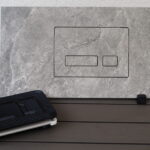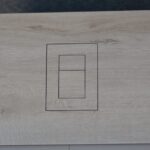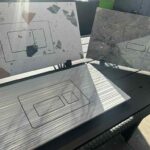
A bathroom can have premium tile, a floating vanity, and carefully selected fixtures, yet still feel unfinished because of one ordinary object on the floor: the wastebasket. A recessed bathroom trash can removes that visual interruption by placing everyday waste exactly where it belongs – discreetly integrated into the wall, accessible when needed, and absent from the room’s overall composition.
This is a small architectural detail with a noticeable effect. It clears floor space, reduces awkward corners around a freestanding bin, and supports the calm, ordered appearance expected from a modern bathroom. For homeowners planning a renovation and professionals specifying every finish, the trash can deserves the same attention as a concealed toilet brush holder or recessed toilet paper storage.
Why a Floor Trash Can Disrupts a Finished Bathroom
A freestanding bathroom bin is functional, but it rarely looks intentional. It occupies visible floor area, competes with the tile layout, and becomes another object to move when cleaning. In compact powder rooms and guest bathrooms, even a narrow bin can make the room feel more crowded than it is.
The problem is not only visual. The space behind and beneath a freestanding bin collects dust, hair, and moisture. A bin can be knocked over, shifted by a robot vacuum, or placed in the wrong spot because there is no defined location for it. These are minor frustrations, but they repeat every day.
Recessing the bin into the wall changes its role. Instead of an accessory added after the bathroom is complete, it becomes a built-in element of the architecture. The waste opening is positioned where it is practical, while the body of the bin is hidden within the wall assembly. The result is clean, elegant, and free of unnecessary visual noise.
What a Recessed Bathroom Trash Can Changes
A built-in trash can is designed for bathrooms where clean lines matter. It creates a fixed, purposeful place for tissues, cotton pads, packaging, and other light daily waste without adding a loose container to the floor.
The most immediate benefit is visual continuity. When the surrounding wall is tiled with precision, a recessed element can be coordinated with the same material language rather than interrupting it. The bathroom retains its clear geometry. Nothing bulky sits next to the vanity, toilet, or shower enclosure.
There is also a practical advantage in circulation. In a smaller bathroom, every inch around the toilet and vanity matters. Removing a floor bin makes movement easier and gives the room a more open character. In a larger luxury bathroom, the benefit is less about saving space and more about maintaining an uncluttered, hotel-level finish.
A recessed solution does involve planning. It needs a suitable wall location, enough cavity depth, and careful coordination before tile installation. That is the trade-off for a result that looks integrated rather than improvised.
Better Hygiene Starts With a Defined Place
A wall-integrated trash can helps simplify cleaning around the toilet and vanity because there is no separate object on the floor. The exposed surfaces are reduced, and the tile floor can be cleaned without moving a bin from side to side.
The interior container should remain easy to remove and empty. Good design does not hide function behind a complicated mechanism. It conceals the bin from view while keeping routine use direct and comfortable. A practical opening, a removable insert, and accessible service are essential details.
The right placement also improves everyday hygiene. Position the bin near the toilet or vanity according to how the room is used, but avoid locations where it interferes with door swings, drawer fronts, or access to concealed plumbing. A precise layout makes the detail feel natural from the first day of use.
Planning the Installation Before Tile Work
A recessed bathroom trash can should be selected early, ideally when the bathroom layout and wall systems are being defined. Waiting until the tile is installed usually means the opportunity has passed or the installation becomes unnecessarily complicated.
Start with the wall construction. A stud wall often provides the most straightforward cavity, but its depth, framing, plumbing runs, electrical wiring, and insulation all need to be checked. A solid masonry wall may require a prepared recess, which should be evaluated carefully so structural integrity is not compromised. In either case, the installer needs the product dimensions before building or cutting the opening.
The installation height matters just as much as the opening size. A bin placed too low may be less comfortable to use and can make removing the container inconvenient. One placed too high can look disconnected from the rest of the bathroom composition. The ideal height depends on the surrounding features, particularly a floating vanity, wall-hung toilet, or recessed toilet paper holder.
Tile layout deserves equal attention. The opening should align with grout lines, niches, flush plates, and other built-in accessories whenever possible. This is where a minimal detail becomes a premium one. A technically correct installation can still look average if the tile cuts are poorly planned. Conversely, an accurately positioned opening can make the whole wall look calmer and more deliberate.
Coordinate With Other Concealed Details
The strongest bathrooms use a consistent design language. If the room includes a concealed toilet brush, recessed paper holder, flush-mounted accessories, or integrated towel hooks, the trash can should be considered as part of that same system.
Avoid placing every built-in element on one wall simply because the cavity is available. Group functions where they are useful, then balance the composition across the room. For example, the trash can may make sense beside the toilet, while towel storage belongs near the vanity or shower. Functional zoning prevents the wall from feeling crowded.
For architects and installers, templates and accurate cutting tools are not secondary accessories. They help create repeatable openings, controlled edges, and precise alignment with commonly used sanitary systems. The visible luxury of a concealed bathroom detail depends on invisible preparation.
Choosing the Right Location for Daily Use
There is no single best location for every bathroom. In a powder room, a position near the toilet is usually practical because most waste is generated there. In a primary bathroom, the bin may work better beside the vanity, where tissues and personal-care packaging are more common.
Consider who will use the space. A guest bathroom benefits from an obvious, intuitive location. A private bathroom can be tailored more closely to the owner’s habits and layout. If accessibility is a priority, the opening should be easy to reach without bending excessively or navigating around fixtures.
Do not place the bin directly in a wet zone. Although a recessed unit can be designed for bathroom conditions, constant water exposure from an open shower is unnecessary and makes maintenance less pleasant. A dry wall area close to the main point of use is usually the most functional choice.
Is a Recessed Bin Right for Every Bathroom?
Not always. A simple freestanding bin may still be the sensible option in a temporary renovation, a rental property with no wall modifications allowed, or a bathroom where wall cavities are occupied by essential services. It can also be more economical when the project does not include new tile work.
But when walls are already being opened and tiled, a built-in bin becomes a smart long-term decision. The incremental planning required is small compared with the lasting improvement in order, floor space, and visual quality. It is especially valuable in premium projects where the goal is not merely to add fixtures, but to remove distractions.
PS-Tile approaches this category as part of a broader built-in bathroom system. The purpose is not to fill a wall with gadgets. It is to give necessary objects a permanent, discreet place so tile, light, and architecture remain the focus.
A well-designed bathroom feels effortless because the practical details have already been resolved. Choose the location carefully, coordinate the opening before tile work, and let the trash can disappear into the wall where it belongs.