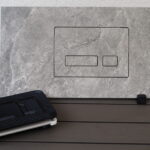
A clean bathroom detail is often decided by a cut only a few millimeters wide. An outlet for a recessed toilet paper holder, a refined corner around a flush plate, or an opening for an integrated accessory must be accurate before the tile reaches the wall. This Proxxon rotary tool review looks at whether the MICROMOT system has the precision, control, and practical value required for this type of work.
For installers, designers, and homeowners who expect a seamless built-in result, a rotary tool is not a replacement for a professional tile saw. It is a finishing instrument. Used in the right place, it can turn difficult small adjustments into clean, controlled details with no unnecessary visual disruption.
Proxxon Rotary Tool Review: What It Is Built For
Proxxon MICROMOT rotary tools are designed around fine mechanical work. Their strength is not maximum cutting depth or aggressive material removal. Their value lies in compact handling, controlled speed, and the ability to work precisely with small accessories and collets.
That character suits bathroom installation work surprisingly well. Tile layouts around recessed accessories rarely fail because a large cut is impossible. They fail because the final adjustment is rushed, an internal corner is chipped, or an opening is widened unevenly. A compact rotary tool gives the installer a more direct view of the working area and more control over pressure than a full-size angle grinder.
The system is particularly useful where a tile needs a small correction after the primary opening has been cut. Think of a narrow notch for a mounting detail, a refined radius at an internal corner, or a slight adjustment to align an opening with a concealed component. These are small operations, but they have a major effect on how clean and intentional the finished wall appears.
Proxxon is not the fastest answer to every tile-cutting task. That is not a weakness. It is simply the right tool category for a different level of detail.
Where a Proxxon Tool Performs Best
The best application is controlled finishing on ceramic, porcelain, natural stone, and similar hard surfaces when the correct diamond accessory is used. For a small opening or a difficult local adjustment, the narrow body and low weight help maintain a steady hand. That matters when the tile is already expensive, the visible edges are close to a finished surface, and there is little room for correction.
A Proxxon tool also works well in confined positions. Recessed bathroom accessories are designed to disappear into the wall, leaving only a precise, elegant opening within the tile field. During installation, that often means working close to adjacent tiles, corners, framing, or a prebuilt installation element. A large machine can feel excessive in these spaces. A compact rotary tool can make the final correction without bringing unnecessary force to the tile.
For professionals, the benefit is repeatability. Once a suitable speed, accessory, and hand position are established, the same kind of fine adjustment can be made consistently across multiple installations. For a homeowner handling a carefully planned renovation, the benefit is confidence: the tool encourages slow, deliberate work rather than forcing a large cut with a machine that is difficult to control at close range.
The Collet Is More Important Than It Looks
A precise tool is only as precise as the connection between the tool and its accessory. This is where the Proxxon MICROMOT collet system deserves attention. A properly matched collet centers the shank securely, helping the diamond burr, small cutting bit, or abrasive run with less wobble.
That detail is critical for fine tile work. A loose or poorly matched accessory can vibrate, wander at the start of a cut, or leave a rough edge that requires more finishing. It can also place uneven stress on a delicate accessory. When the goal is a clean opening around a built-in component, that loss of control is immediately visible.
Before beginning, confirm the shank diameter of the accessory and use the corresponding collet. Insert the shank fully enough for a secure grip, but do not force it against the bottom if the tool instructions advise otherwise. Tighten it correctly, then briefly run the tool before touching the tile. If the accessory visibly oscillates, stop and correct the setup.
This preparation takes moments, yet it supports the clean lines that define a premium bathroom. Precision is not only about the tool in hand. It is the result of every small decision around it.
Speed, Pressure, and the Risk of Chipping
A common mistake with a rotary tool is treating it like a miniature grinder. More pressure does not automatically produce a better cut. On glazed ceramic or porcelain, pushing too hard can overheat the contact point, wear the accessory prematurely, and increase the risk of chipping at the surface.
Let the diamond accessory do the work. Begin with a light touch, establish the line gradually, and remove material in short passes. For an opening that must remain crisp, it is usually better to approach the line slowly than to attempt the finished dimension immediately. This is especially true on a dark, polished, or large-format tile, where even a small chip can interrupt an otherwise elegant wall surface.
Speed selection depends on the material and accessory. Higher speed can be effective for controlled fine grinding, but it also generates heat quickly. Lower or moderate speed may offer better control at the edge of a finished face. The correct setting is not universal, so test on an offcut of the same tile whenever possible.
Dust control also deserves planning. Dry work creates fine particulate dust that should not be allowed to settle on finished surfaces or circulate through the room. Prepare the work area, use appropriate extraction where practical, and protect adjacent tile faces. A precise cut should not leave a careless cleanup problem behind it.
What a Rotary Tool Cannot Replace
This review is most useful when its limits are clear. A Proxxon rotary tool should not be the primary choice for long straight cuts, large rectangular openings, or deep, continuous cuts through thick porcelain. A quality manual cutter, wet saw, or suitable diamond blade will generally produce those cuts faster and with more consistent edges.
It is also not the ideal first tool for heavy demolition or removing a large amount of material. A rotary tool is compact by design. Asking it to do high-volume work can reduce efficiency and shorten accessory life.
The practical approach is to use each tool where it performs best. Make the major cut with the equipment intended for the job, then use the rotary tool for the final millimeters, tight corners, small radii, or corrections that determine the visual quality of the installation. This combination is faster than forcing one machine to perform every task, and it protects the tile from unnecessary risk.
Is Proxxon Right for Your Bathroom Project?
For an installer working with recessed details, Proxxon MICROMOT tools are a strong addition to the precision end of the toolkit. They are particularly valuable when installing components that must sit cleanly within a tiled wall, where a rough opening would undermine the effect of an otherwise minimalist design.
For a homeowner, the answer depends on the project. If the work involves one simple straight cut, a rotary tool may be unnecessary. If the installation includes carefully finished openings, detailed accessories, or premium tile that leaves no margin for sloppy correction, the control it provides becomes far more valuable.
PS-Tile focuses on built-in bathroom solutions because the smallest visible details shape the entire room. A recessed accessory removes clutter, but only a precise installation allows it to look truly integrated. Choose the cutting tool for the scale of the task, reserve the rotary tool for the details that demand control, and let every finished edge support the quiet, elegant result the design deserves.