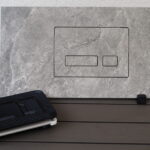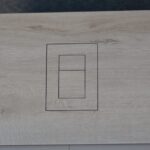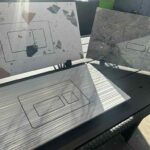
A wall-hung toilet can be one of the cleanest elements in a modern bathroom, yet a conventional chrome or plastic flush plate often interrupts the entire composition. Can flush plates match tiles? Yes. A tile-integrated flush plate allows the activation surface to visually continue the wall finish, replacing a separate-looking control with a precise architectural detail.
The result is not simply a hidden button. It is a calmer bathroom wall, fewer competing materials, and a finish that feels considered from the first tile to the final joint. For projects built around large-format porcelain, natural stone, microcement-look tile, or carefully aligned grout lines, that difference is immediately visible.
Can flush plates match tiles without losing function?
They can, provided the flush plate is designed as an integrated system rather than as a decorative cover fitted afterward. A proper tileable flush plate uses the same tile as the surrounding wall while retaining the mechanical access and reliable actuation required by the concealed cistern.
This distinction matters. The tile is not permanently sealing the service opening. The finished panel remains removable, giving access to the cistern’s service components when maintenance is needed. Behind the clean surface, the installation must still allow the flush mechanism to be adjusted, inspected, or serviced.
A well-executed tile-matched plate creates a near-continuous wall plane. Depending on the system and chosen design, the flush area may be indicated by subtle joints, a narrow shadow gap, discreet push zones, or a precisely machined opening. It gives the user a clear point of interaction without introducing a visually dominant rectangle in chrome, black glass, or white plastic.
Why a tile-integrated flush plate changes the room
Bathrooms are often compact, which makes every visible element more influential. A traditional flush plate may be small, but it sits at eye level and contrasts with the wall by design. In a minimal bathroom, that contrast can pull attention away from the tile layout, vanity, lighting, and sanitaryware.
Matching the plate to the tile creates three practical advantages.
First, it protects the visual continuity of the wall. This is especially valuable with veined stone-look porcelain or large-format slabs, where the pattern can continue across the flush area instead of stopping around a separate fitting. With a grid-based tile layout, it also helps maintain disciplined lines rather than introducing another shape into the composition.
Second, it makes cleaning simpler. Flat, integrated surfaces have fewer exposed edges and fewer places where dust, moisture, and residue can collect. The benefit is not that a tileable plate eliminates cleaning, but that it avoids the layered profile and narrow perimeter common with many surface-mounted plates.
Third, it supports a more permanent design language. Finish trends change quickly. A brushed brass or matte black plate can be beautiful, but it ties the wall to a specific metal finish. Tile remains the dominant surface, so a matching plate usually ages more quietly and keeps the room visually flexible.
The detail depends on the tile
Not every tile should be handled in the same way. The most elegant result comes from planning the flush plate at the same time as the wall layout, not after tiling has begun.
Large-format porcelain and stone-look slabs
Large-format tiles are ideal for a tile-integrated flush plate because they reduce the number of grout lines on the wall. If the pattern, vein, or directional texture is aligned carefully, the flush zone can appear almost invisible at first glance.
That precision raises the standard for cutting. The tile panel must be measured accurately, its edges must be clean, and the opening must be positioned in relation to the tile pattern rather than only to the cistern frame. A rushed cut is highly visible on a calm, expansive surface.
Natural stone deserves additional care. Vein direction, thickness variation, and edge finishing can affect the final fit. The visual effect can be exceptional, but stone should be evaluated for weight and suitability with the selected mounting system.
Small-format and patterned tile
Mosaic, handmade-look ceramics, and strongly patterned tiles can also work, but they introduce more decisions. A flush panel crossing multiple small tiles may make the removable section more noticeable, particularly where grout joints do not align perfectly.
In these projects, the flush plate can still look refined when the panel boundaries follow the tile module and grout lines are planned deliberately. Sometimes a discreet frame or shadow joint is the better design choice. Trying to make every plate completely invisible is not always the most luxurious solution. A clean, intentional reveal often looks more precise than a poorly disguised opening.
Textured, thick, or uneven surfaces
Deeply textured tile, split-face stone, and heavily reliefed finishes may not be suitable for every tileable plate system. The moving panel needs predictable clearances, and a surface with irregular edges can interfere with smooth operation.
Tile thickness matters as well. Before selecting a system, confirm its permitted tile thickness, the combined thickness of tile and adhesive, and the clearance around the finished panel. These measurements should guide the specification before the wall is closed.
Precision starts behind the tile
The finest visible result depends on work that happens before the tile is installed. The concealed cistern frame must be set at the correct depth, level, and height. The tileable plate system must match the chosen cistern and its flush actuation arrangement. Compatibility with common concealed systems, including Geberit and Grohe configurations where applicable, should be confirmed early.
This is not a detail for improvisation on the final day of a bathroom renovation. If the wall opening is inaccurate, if the carrier frame is out of level, or if the tile layout was never coordinated with the plate, the finished wall can look compromised even when the components themselves are premium.
Professional templates are valuable here because they transfer exact dimensions from the concealed installation to the tile. They help locate cutouts, preserve the required service opening, and keep the flush panel centered and level. For an installer, the template is not an accessory. It is part of achieving the crisp, repeatable result that a built-in detail demands.
The cut quality deserves the same attention. Porcelain and sintered stone can chip at the edge if cut with unsuitable equipment or poor technique. A quality diamond blade, stable manual cutter, and careful finishing create edges that sit cleanly against neighboring tile. The wall should look intentionally engineered, not merely adapted around plumbing.
What to decide before ordering
A tile-matched flush plate works best when the designer, installer, and homeowner agree on a few fundamentals before materials arrive on site. The concealed cistern model, the tile thickness, wall build-up, flush plate dimensions, and desired grout alignment all influence each other.
Also decide how visible the flush function should be. Some owners want the plate to disappear almost entirely. Others prefer a subtle reveal that makes operation intuitive for guests and service technicians. Both approaches can be elegant. The right choice depends on whether the room prioritizes absolute visual minimalism or immediate legibility.
Lighting is another overlooked factor. Side lighting can reveal small differences in plane and joint width that are invisible under general ceiling light. In a premium bathroom, inspect the flush panel under the same lighting conditions that will be used after completion.
Avoid the common shortcuts
The most frequent mistake is treating the flush plate as a finish selection made after the plumbing and tile are complete. At that stage, options become narrower and compromises become expensive.
Another shortcut is using a generic tile panel without verifying service access or actuator compatibility. A wall may look clean on installation day but become difficult to maintain later. A truly functional integrated solution preserves access without sacrificing the surface quality.
Finally, do not assume that matching means hiding every joint. Fine, consistent shadow lines can be part of the design. They define the removable panel, protect its movement, and give the wall a technical precision that suits contemporary architecture.
A tile-integrated flush plate is a small component with an outsized effect. It allows the wall finish to remain the focus while the technology behind it stays discreet, accessible, and reliable. When planned with the same care as the tile layout itself, it turns a necessary control into a quiet expression of order, luxury, and function.